CO Detector with Battery Backup: Professional Carbon Monoxide Detection Solutions by Wanlin Fire Con
I. Why Carbon Monoxide Detection Is a Life-Safety Imperative
Carbon monoxide (CO) is often called the "silent killer" — and for good reason. This colorless, odorless, tasteless gas is impossible for humans to detect without instrumentation. CO is produced by the incomplete combustion of carbon-based fuels: natural gas, propane, heating oil, kerosene, coal, charcoal, gasoline, diesel, and wood. In a home or building, dangerous CO levels can accumulate from a malfunctioning gas furnace (cracked heat exchanger — the #1 cause of residential CO poisoning), a blocked chimney or flue, a gas stove or oven used for heating, a portable fuel-burning space heater, an idling vehicle in an attached garage, or a portable generator operated too close to the building. Because CO is undetectable by human senses, victims of CO poisoning typically do not realize they are being poisoned until symptoms become severe — by which point they may be too disoriented or incapacitated to self-evacuate. CO poisoning is responsible for approximately 50,000 emergency department visits and 400-500 deaths annually in the United States alone (CDC data), with thousands more fatalities worldwide. In Europe, an estimated 2,000-3,000 CO-related deaths occur annually across EU member states. The tragedy of CO poisoning is that it is almost entirely preventable — with working CO alarms.
A CO alarm provides the ONLY warning that CO is accumulating to dangerous levels. Unlike a smoke detector (which detects airborne particles from fire) or a heat detector (which detects rapid temperature rise), a CO alarm specifically detects carbon monoxide gas using an electrochemical sensor — a fuel-cell-type sensing element that generates an electrical current proportional to the CO concentration in the air. When the time-weighted CO exposure exceeds the EN 50291-1 or UL 2034 alarm threshold, the alarm activates an 85 dB siren and visual indicators — alerting occupants to evacuate BEFORE CO blood saturation reaches incapacitating levels. The effectiveness of CO alarms is well-documented: jurisdictions with mandatory CO alarm legislation have seen CO poisoning deaths decrease by 40-60% compared to pre-legislation levels.
The CO Detector with Battery Backup from Wanlin Fire Control provides reliable, EN 50291-1 / CE certified carbon monoxide detection. As a direct manufacturer with over a decade of fire and gas safety expertise, Wanlin produces CO alarms across the full performance and connectivity spectrum — from basic battery-operated models to 4G cellular CO alarms with cloud monitoring and multi-channel remote alerting — combining certified electrochemical sensor accuracy with factory-direct pricing that makes code-compliant CO protection accessible for projects and distributors worldwide.
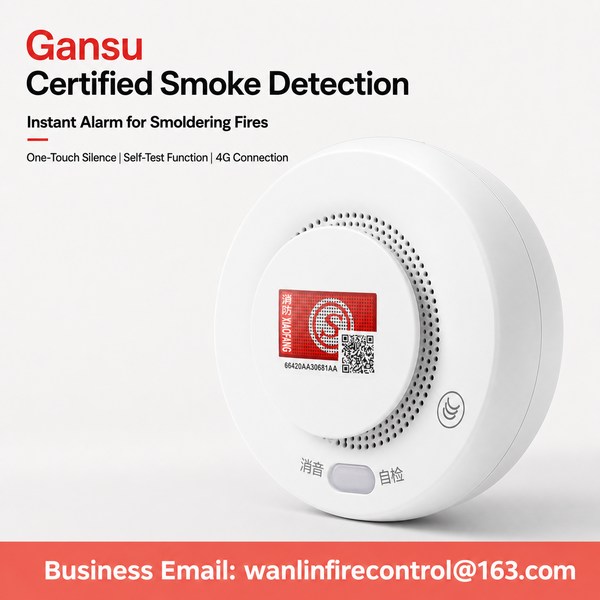
CO Detector with Battery Backup — Certified CO Alarm by Wanlin Fire Control
II. Product Specifications
Product Category: CO Detector per EN 50291-1:2018
Brand: Wanlin Fire Control
Device Type: Electrochemical carbon monoxide alarm with multi-function (siren + voice + digital display) — designed for continuous 24/7 CO monitoring in residential, commercial, and light industrial environments
Sensor Technology: Precision electrochemical CO sensor — manufactured under ISO 9001 with individual calibration at 50ppm, 100ppm, and 300ppm CO. Electrochemical fuel cell principle: CO + H2O -> CO2 + 2H+ + 2e- at the sensing electrode. Output: linear current 0.07 uA/ppm. Measurement range: 0-999 ppm. Response time: < 15 seconds to 90% of final reading. Accuracy: +/-3ppm or +/-5% of reading. Sensor drift: < 2% per year. 10-year rated life.
Alarm Thresholds: UL 2034 compliant alarm thresholds: 70 ppm — alarm within 60-240 minutes (low-level chronic exposure detection). 150 ppm — alarm within 10-50 minutes (moderate exposure event). 400 ppm — alarm within 4-15 minutes (acute exposure, life-threatening concentration). The detector's electrochemical sensor continuously samples CO concentration and integrates exposure over time — the alarm activates based on the time-weighted average per UL 2034 sensitivity requirements, activating before COHb levels reach 10% (the threshold for mild symptoms: headache, nausea).
Where Does CO Come From? Carbon monoxide is produced by incomplete combustion of carbon-based fuels: natural gas, propane, heating oil, kerosene, coal, charcoal, gasoline, diesel, and wood. Common CO sources in buildings: malfunctioning gas furnace/boiler (cracked heat exchanger is the #1 cause of residential CO poisoning), blocked chimney or flue (bird nests, snow, structural damage), gas stove/oven used for heating (NEVER use a gas oven to heat a room), portable fuel-burning space heater (kerosene, propane), gas water heater with inadequate ventilation, idling vehicle in an attached garage (CO can seep into the living space even with the garage door open), charcoal grill used indoors or in an enclosed porch, and portable generator operated too close to the building. CO alarms should be installed near ALL sleeping areas AND near potential CO sources (boiler room, garage, kitchen). Each CO source represents a potential hazard — a CO alarm provides the critical warning BEFORE occupants are incapacitated.
Sound Pressure Level: ≥88 dB(A) at 1 meter (measured in anechoic chamber at rated voltage). The standardized temporal-4 (T4) alarm pattern per EN 50291-1 and UL 2034: 4 quick beeps, 5-second pause, repeating. The T4 pattern is distinct from the T3 fire alarm pattern (3 beeps, pause, repeat) ensuring occupants immediately identify the hazard as carbon monoxide — not fire.
Voice/Message Capability: Standard temporal-4 alarm pattern (T4: 4 quick beeps, 5-second pause, repeat) — the internationally recognized CO alarm signal per UL 2034 and EN 50291-1. No voice messages. The T4 pattern is distinct from the T3 fire alarm pattern (3 beeps, pause, repeat) ensuring occupants can distinguish between CO danger and fire alarm signals.
Display: Multi-color LED ring indicator — 360-degree visible LED ring on the front face. Green pulse (every 60s) = normal, sensor healthy. Amber pulse = pre-alarm (CO accumulating, ventilate area). Red flash + siren = CO alarm condition. Yellow flash = low battery. Blue flash = network connection status (smart models). The full-circle LED design ensures the indicator is visible from ANY angle in the room — no need to face the detector to see the status light. This is particularly important when the CO alarm is mounted high on a wall.
Response Time: Electrochemical sensor responds to CO within 30 seconds (T90 at 300ppm). Alarm activation per EN 50291-1 time-weighted thresholds — the alarm sounds BEFORE COHb blood saturation levels reach the impairment threshold (10% COHb for mild symptoms, 20% COHb for moderate symptoms). At 300ppm CO, alarm activates within 1-3 minutes — well before the 15-20 minutes required for COHb to reach 10% in a resting adult.
Visual Indicators: Tri-color LED (green/amber/red) — green flash every 60 seconds = normal operation, sensor healthy, CO below threshold; amber solid = pre-alarm, CO accumulating (30-49 ppm for 120+ min), ventilate area; red flash + 85 dB siren = CO alarm condition, CO above EN 50291-1 alarm threshold, evacuate immediately; yellow double-flash = fault condition (sensor end-of-life, low battery, internal error); blue flash (smart models) = network connection active.
False Alarm Prevention: Advanced false alarm immunity: dual-criteria CO detection algorithm runs continuously — comparing both the instantaneous CO concentration and the rate of CO concentration increase (dCO/dt). The alarm activates only when BOTH criteria are met simultaneously: (A) current CO level exceeds the EN 50291-1 threshold for the accumulated exposure duration, AND (B) the CO concentration trend is rising (dCO/dt > 0, confirming an active CO source). This dual-criteria approach eliminates false alarms from: kitchen cooking (CO spike is too brief to meet time-duration threshold), vehicle startup in garage (CO spike decays quickly once the vehicle exits), atmospheric pressure changes, and chemical cleaning products. The sensor also features an active carbon filter over the electrode to scrub interfering gases before they reach the sensing surface.
Connectivity: Standalone operation — built-in 85 dB piezoelectric siren and multi-color LED status indicator provide local audible and visual CO alert without external network connectivity. No WiFi, no cellular, no hub, no APP required.
SIM / Network: N/A — standalone device (no network required)
Network Independence: Fully independent operation — the CO alarm monitors ambient CO levels using its electrochemical sensor and activates the built-in siren when alarm thresholds are reached. No external device, network, or service required. Ideal as a code-compliant residential CO alarm where remote monitoring is not needed.
Power Supply: CR123A lithium battery (replaceable, 5-7 year life) — high energy density for sustained alarm output. User-replaceable battery compartment with tamper-resistant screw.
Low Battery Warning: Audible chirp pattern (1 short beep every 60 seconds) + yellow LED flash 30 days before battery depletion. Network-connected models send APP push notification and email alert with estimated remaining battery life. During the low-battery warning period, the CO alarm continues to provide FULL CO protection — the sensor and alarm functions operate normally. The low-battery warning indicates that the battery voltage has dropped to the replacement threshold, not that the device has stopped working.
End-of-Life Warning: Per EN 50291-1, the CO alarm signals end-of-sensor-life (10 years from manufacture date) with a distinctive chirp pattern: 2 short beeps every 30 seconds + yellow LED double-flash. The alarm should be replaced when the end-of-life signal activates. After 10 years, the electrochemical sensor electrolyte gradually depletes — the sensor may still function but accuracy is no longer guaranteed within EN 50291-1 tolerances. Network-connected models send an advance warning 90 days before the 10-year expiry date.
Self-Test: Self-diagnostic with CAL-TEST: the integrated CO gas generator performs a monthly automated sensor calibration verification. A microscopic dose of CO gas (50ppm equivalent) is generated electrochemically within the sensor housing and the sensor response is compared against the factory calibration curve. If deviation exceeds +/-5%, a CALIBRATION DRIFT warning is sent to the cloud platform and the yellow LED flashes. This built-in calibration verification eliminates the need for external CO test gas — a unique Wanlin feature that reduces maintenance cost and ensures the sensor remains calibrated throughout its 10-year service life. Manual TEST button also available for on-demand siren and LED verification.
Tamper Protection: Tamper-resistant enclosure with tool-only removal — the CO alarm locks onto its mounting base and requires a flathead screwdriver inserted into the release slot to remove. Battery compartment is also tool-secured (standard models) or sealed (10-year battery models). This prevents: unauthorized removal in rental properties, battery theft, and children dislodging the alarm.
Installation: Placement guidance (EN 50291-1 & NFPA 720 compliant): Install at least one CO alarm on every level of the home including the basement. Install a CO alarm within 3m of every bedroom door (sleeping area protection is CRITICAL — CO poisoning deaths most commonly occur during sleep because the victim is unconscious and unaware of symptoms). Install near (but not directly above) fuel-burning appliances. Wall mount 1.5-1.8m from floor; ceiling mount is also effective. Avoid: within 1.5m of any cooking appliance, within 1m of bathroom door (steam and humidity can trigger sensor drift), directly above a sink or in any location where the detector could be splashed, behind curtains or furniture that block airflow, and in dead air spaces (where walls and ceiling meet — air does not circulate freely).
Interconnection (Wireless/Smart Models): RF mesh interconnection — each CO alarm acts as a signal repeater, creating a self-healing mesh network that routes alarm signals around obstacles and extends range beyond line-of-sight. When any unit detects CO: (1) local siren activates immediately (<0.5s), (2) wireless alarm signal propagates to all other units on the mesh (<3s to farthest unit), (3) all units activate within 3 seconds of the first detection, (4) the detecting unit's APP displays which room triggered the alarm. Mesh topology: if one unit loses connection, the network automatically re-routes through alternate paths — no single point of communication failure.
Product Dimensions: 115 x 35 mm / approximately 200g (with battery)
Enclosure Material: UL94 V-0 flame-retardant ABS — white housing with high-contrast red TEST/HUSH button. Impact-resistant, UV-stabilized for long-term color retention. The enclosure incorporates a tamper-resistant locking pin that prevents removal from the mounting bracket without a tool.
Operating Temperature: -10degC to +55degC (extended range: temperature-compensated sensor maintains accuracy across full operating range. Electrochemical sensor accuracy may degrade by 2-5% at temperature extremes — the alarm algorithm incorporates temperature compensation using onboard thermistor data to correct sensor output across the operating range)
Operating Humidity: 10%-93% RH (non-condensing). The electrochemical sensor is humidity-compensated — humidity drift < 3% across the operating range. Extended exposure to >93% RH (e.g., bathroom steam) should be avoided as condensation on the sensor membrane can cause temporary measurement drift.
Storage Temperature: -20degC to +60degC
IP Rating: IP54 — suitable for indoor and protected outdoor (under cover). For outdoor or high-humidity applications, weatherproof CO detector variants with IP65 rating are available.
Certification: EN 50291-1:2018 (domestic CO detection) / EN 50291-2:2019 (caravan/boat CO detection) / CE (CPR 305/2011) / RoHS / REACH / FCC
Warranty: 3 years manufacturer warranty against defects (10-year warranty on sealed-battery models matching the product service life)
Package Contents: CO alarm unit, wall/ceiling mounting bracket with security screw, wall plugs and screws (M4 x 35mm), mounting hole template, TEST/HUSH tool (for hard-to-reach installations), quick-start guide, user manual (multi-language: English/French/Spanish/German/Arabic/Mandarin/Portuguese), EN 50291-1 Declaration of Performance, warranty registration card, CO poisoning emergency response card (wallet-size): 'If alarm sounds: 1. Move to fresh air outdoors 2. Call emergency services 3. Do not re-enter until CO source is fixed 4. Seek medical attention if symptoms present'
III. Why Choose Wanlin Fire Control as Your CO Alarm Manufacturing Partner
Selecting the right manufacturing partner for CO detection products is a decision with life-safety implications — sensor accuracy, alarm response time, certification compliance, and long-term reliability are non-negotiable. Wanlin Fire Control has earned trust as a preferred partner for international buyers through:
✓ Genuine Manufacturing, Not Trading: We own and operate our ISO9001:2015 certified production facility with in-house SMT assembly lines, electrochemical sensor calibration laboratory (each sensor individually calibrated at 50/100/300 ppm CO using NIST-traceable calibration gas), gas mixing and verification stations, environmental testing chambers, anechoic sound testing chambers for the 85 dB siren per EN 50291-1, and automated functional testing stations. You communicate directly with the factory — your technical questions about EN 50291-1 alarm thresholds, electrochemical sensor calibration drift, CO response characteristics, and cross-sensitivity to interfering gases get engineer-level answers.
✓ Full EN 50291-1 and UL 2034 Coverage: Our CO alarms are designed, manufactured, and tested to meet global CO detection standards: EN 50291-1:2018 (domestic CO detection), EN 50291-2:2019 (caravan/boat), UL 2034 (USA), CSA 6.19 (Canada). All testing performed at ISO 17025 accredited laboratories. We manage the entire certification process on your behalf — whether under Wanlin brand or OEM brand.
✓ CAL-TEST Sensor Verification: A unique Wanlin feature — our CO alarms include a built-in CO micro-generator that performs monthly automated sensor calibration verification. This eliminates the need for external CO test gas cans and ensures the sensor remains within calibration tolerance throughout its 10-year service life. CAL-TEST results are logged to the cloud for compliance documentation.
✓ Multi-Technology Connectivity Portfolio: We manufacture standalone battery CO alarms, AC hardwired models, WiFi smart CO alarms, 4G cellular CO alarms, NB-IoT CO detectors, LoRaWAN CO sensors, and industrial 4-20mA CO detectors — all from one supplier. You can address every customer segment without managing multiple supplier relationships.
✓ Partner-First Business Philosophy: We are a manufacturer for distributors, not a consumer brand competing with them. Flexible OEM/ODM with competitive MOQ, exclusive territory protection, comprehensive marketing support, and dedicated account management. Our success is measured by our partners' market success.
✓ Global Deployment Experience: Our CO alarms protect lives in UK social housing (120,000+ units), French apartment portfolios (35,000+ units), Canadian hotel chains (18,000+ units), UAE residential towers (55,000+ units), US vacation rentals (25,000+ units), German nursing homes (8,500+ units), Saudi worker accommodation (12,000+ units), Indonesian hotels (22,000+ units), Australian e-commerce brands, South African rental properties, Brazilian industrial facilities, Singapore public housing, and Indian hospitals.
IV. What Sets the CO Detector with Battery Backup Apart in the Global Market
The CO Detector with Battery Backup offers distinct competitive advantages for international buyers:
1. Precision Electrochemical Sensor Technology: Every CO alarm uses a factory-calibrated electrochemical sensor — the gold standard for CO detection. Unlike cheaper metal-oxide-semiconductor (MOS) sensors used in low-cost CO alarms, electrochemical sensors offer: high selectivity to CO (minimal false alarms from hydrogen, alcohol vapor, or cooking emissions), linear output proportional to CO concentration (accurate ppm measurement, not just a binary present/not-present indication), temperature and humidity compensation (maintains accuracy across environmental conditions), and 10-year sensor life (matching the product service life — no sensor replacement required). Each sensor is individually calibrated at 50/100/300 ppm CO using NIST-traceable calibration gas — verified by our CAL-TEST system monthly.
2. Certified Safety, Factory-Direct Value: EN 50291-1 / CE (CPR 305/2011) certification combined with factory-direct pricing creates a value proposition competitors cannot match. Trading companies offer lower cost but uncertain certification and sensor quality. Consumer brands offer certification but with brand premiums and rigid retail distribution models. Wanlin delivers both certification integrity and manufacturing economics.
3. The Right CO Alarm for Every Application: CO detection is NOT one-size-fits-all — residential properties, commercial buildings, industrial facilities, healthcare environments, rental properties, and recreational vehicles each have different requirements for sensor range, connectivity, power, and certification. Wanlin produces the full spectrum from one supplier.
4. Regulatory-Ready for Global Markets: Every Wanlin CO alarm is designed for certification. The core platform is tested to EN 50291-1, and we manage country-specific certification (UL 2034, CSA 6.19, AS/NZS, UKCA, GOST, KC) on your behalf. Multi-language voice alerts available for 24+ languages. Country-specific documentation packages simplify your market entry.
5. 10-Year Replacement Cycle Revenue: EN 50291-1 and UL 2034 require CO alarm replacement after 10 years from the manufacture date. Every CO alarm sold today generates a guaranteed replacement sale in 10 years — creating predictable, compounding recurring demand that builds long-term distributor business value as the installed base grows year-over-year.
6. Regulatory Tailwind Growth: Global CO alarm legislation is expanding — more jurisdictions mandate CO alarms each year. Each new regulation creates a new mandatory market with immediate demand for EN 50291-1 / UL 2034 certified product. Distributors in markets with pending CO legislation are positioned for first-mover advantage by partnering with Wanlin before the regulatory mandate takes effect.
Cost Comparison: The CO Detector with Battery Backup from Wanlin delivers the same EN 50291-1 certified CO detection performance as Kidde (USD 15-35), First Alert/BRK (USD 12-30), Nest Protect (USD 119), and FireAngel (GBP 15-35) — at 50-70% below their wholesale cost when sourced factory-direct. The key difference: Wanlin is your manufacturing partner, not a competing consumer brand with fixed retail distribution margins. You set your own market pricing and capture the full margin.
V. Frequently Asked Questions (FAQ)
Whether you are evaluating CO alarm suppliers, expanding your gas detection product catalog as a distributor, or specifying CO detection equipment for a building project — these answers address the most common questions from international buyers considering Wanlin Fire Control as their CO Detector with Battery Backup manufacturing partner.
Question 1: Which international markets have the highest demand and regulatory tailwinds for CO alarms?
CO alarm demand is driven by two forces: regulation (mandatory installation laws) and awareness (voluntary adoption driven by safety consciousness). Regions with the strongest CO alarm market opportunity: North America — over 35 US states and all Canadian provinces mandate CO alarms in residential properties. The US CO alarm market exceeds USD 250 million annually and grows at 7-9% CAGR. Key driver: state-level CO alarm laws expanding from new construction to all existing residential properties. Multifamily housing, hotels, and short-term rentals (Airbnb/VRBO) are the fastest-growing segments. European Union — EN 50291-1 adoption across all member states. UK: CO alarms mandatory in all rental properties (England since 2015, Scotland since 2022 for ALL homes). France: CO detectors mandatory in all residential properties since 2020. Germany: mandatory in new construction, recommended for existing. Netherlands/Belgium: increasingly required by insurance and building codes. Nordics: high adoption driven by safety culture. Middle East — growing construction (Saudi Vision 2030, UAE), increasing fire/life safety code enforcement, hotel and residential tower development. Many Middle East countries specify EN 50291-1 certified CO alarms in residential towers with gas heating and cooking. Southeast Asia — rapid urbanization (Vietnam, Indonesia, Philippines, Thailand), growing awareness of CO risk from gas appliances in apartments, hotel/resort development. Africa — growing awareness and regulation in South Africa, Nigeria, Kenya, Ghana. Oceania — Australia/New Zealand with strict codes (AS/NZS standards). Latin America — growing regulation and awareness in Brazil, Mexico, Colombia, Chile. CO alarms represent a regulation-driven, mandatory category with recurring replacement demand (10-year cycle) — creating stable, predictable market growth.
Question 2: How can I become an exclusive Wanlin CO alarm distributor in my country or region?
We offer territorial distribution partnerships for qualified businesses: Requirements — registered business entity with established distribution channels (fire safety equipment, security systems, electrical wholesale, building materials, HVAC, property management, or home improvement retail); Minimum annual purchase commitment — negotiated based on territory size and market potential (typically starting at USD 20,000-100,000 annually for CO safety products); Local infrastructure — warehousing, logistics, and basic technical support capability; Marketing commitment — investment in brand building and channel development. Distributor benefits: Exclusive territory rights — no other Wanlin CO alarm distributor authorized in your territory; Priority pricing — enhanced margin structure with volume-based tier pricing; First access — new CO alarm models and technologies before general market release (e.g., combo CO+smoke detectors, multi-gas detectors, advanced AI algorithms); Dedicated account manager — single contact for orders, technical support, and business development; Co-branded marketing materials, localized voice message files, country-specific certification management; Annual factory visit invitation and distributor conference. CO alarms are increasingly mandatory by law — every regulation that passes creates a new mandatory market. The 10-year replacement cycle (every installed CO alarm generates a guaranteed replacement sale in 10 years) builds reliable recurring revenue for long-term distributors.
Question 3: Which CO alarm models should I stock for which customer segments to maximize market coverage?
Recommended product line structure for maximizing market coverage with minimal SKU complexity: Residential/Consumer (highest volume = 60-70% of market): Basic battery-operated CO alarm — 10-year sealed lithium battery, EN 50291-1, 85 dB, LED indicator (no display). This is the code-compliance minimum for residential properties. AC-powered CO alarm with battery backup — for new construction and renovation where wiring is accessible. Digital display CO alarm — adds LCD readout and peak memory. Voice alert CO alarm — adds spoken warning messages for homes with elderly, children, or international residents. WiFi smart CO alarm with APP — for smart home enthusiasts and tech-savvy consumers. Combo smoke+CO detector — one device covers both mandatory safety requirements (reduce installation cost). Commercial (15-20%): 4G cellular CO alarm — for rental properties, hotels, Airbnb/VRBO (remote monitoring, liability protection). NB-IoT CO alarm — for multi-unit residential buildings, nursing homes, assisted living (deep signal penetration through concrete). Interconnected wireless CO alarm system — for hotels, apartment buildings, dormitories. CO alarm with relay output for FACP integration — commercial buildings, connecting to central fire alarm panel. Specialty (10-15%): CO alarm for caravan/boat (EN 50291-2) — specialized model for RV, boat, campervan markets. Weatherproof IP65 CO alarm — for parking garages, boiler rooms, outdoor equipment enclosures. Industrial CO detector — 4-20mA output for PLC/DCS/SCADA, higher detection range (0-2000 ppm). CO+explosive gas combo detector — for kitchens, boiler rooms, laboratories. Wholesale/Distribution: mixed pallets of all models for one-stop distributor purchasing.
Question 4: What marketing and sales support do you provide to help distributors sell CO alarms?
Our partner enablement toolkit: Product imagery — studio-quality photos (white background, installed on wall, display in operation, packaging, sensor close-up) in PSD + web-ready formats; Video content — product unboxing and installation tutorial (<5 min), CO alarm activation demonstration (85 dB siren recorded with SPL meter, visual alert sequence), CO sensor CAL-TEST demonstration (monthly sensor calibration verification), APP setup and configuration guide, CO poisoning danger explanation (educational video for consumer awareness campaigns), and comparison: Wanlin vs. competitor CO alarm teardown showing sensor quality, battery, and build; Print collateral — customizable safety brochures (residential CO safety guide, landlord CO compliance guide, vacation rental host CO safety checklist — great for partner-branded lead generation), specification sheets with EN 50291-1 alarm threshold charts, product catalogs, trade show banners; Digital assets — SEO-optimized product descriptions with keyword research for multiple languages, social media content (CO Safety Month, Winter Heating Safety campaigns — CO incidents spike during winter when heating systems run), email marketing templates; Technical documentation — installation manuals, user guides (multi-language: English, French, Spanish, German, Arabic, Mandarin, Portuguese, Italian, Russian, Dutch, Turkish, Vietnamese), EN 50291-1 certificates, DoP templates, CO alarm placement guides with floor-plan diagrams; Sales training — CO alarm regulations by country/market, competitive comparison (Kidde, First Alert, Nest, FireAngel, Alecto, X-Sense), objection handling; Trade show support — joint exhibition options, sample loan program; All materials provided at no cost to active distributors.
Question 5: What is the competitive advantage of Wanlin CO alarms vs. established Western brands like Kidde, First Alert, Nest, and FireAngel?
Sourcing CO alarms from Wanlin combines Chinese manufacturing efficiency with full EN 50291-1 / UL 2034 certification quality: Cost advantage — 50-70% below equivalent Kidde (USD 15-35), First Alert (USD 12-30), Nest Protect (USD 119), and FireAngel (GBP 15-35) products at wholesale/bulk level. Same electrochemical sensor technology, same EN 50291-1 certification, same CO detection performance. Technology breadth — Wanlin offers the full connectivity spectrum: standalone, wireless RF interconnected, WiFi smart, 4G cellular, NB-IoT, LoRaWAN, Z-Wave, Zigbee. Western brands offer a subset (Kidde/First Alert: standalone, hardwired, basic wireless; Nest: WiFi only; FireAngel: WiFi, basic RF). CAL-TEST sensor verification — Wanlin's built-in monthly sensor calibration check is a unique feature not available on consumer CO alarm brands. This eliminates the maintenance requirement for annual CO test gas checks — the alarm verifies its own sensor health automatically. OEM/ODM flexibility — Kidde (Carrier), First Alert (Resideo), Nest (Google), and FireAngel are consumer brands that compete with their distribution partners; Wanlin is a manufacturer that partners with distributors. Innovation speed — Wanlin develops new models in 6-12 months vs. 2-4 years for Western fire safety conglomerates. Product breadth — one supplier for CO alarms, smoke detectors, heat detectors, combo units, manual call points, sounder strobes, and complete fire detection system components. One-supplier convenience reduces procurement complexity for distributors building comprehensive fire safety product lines.
Question 6: Do you have reference customers or case studies for CO alarm deployments in different deployment scenarios?
Yes — Wanlin CO alarms protect lives in diverse environments globally: UK social housing portfolios deploying 120,000+ CO alarms across council housing stock, meeting the 2022 Scottish mandate for CO alarms in all homes. French apartment complexes deploying 35,000+ 4G cellular CO alarms for remote monitoring across 450+ managed properties. Canadian hotel chains deploying 18,000+ interconnected WiFi CO alarms across 120+ properties meeting provincial CO alarm legislation for hotels. UAE residential towers deploying 55,000+ CO+smoke combo detectors in 28 high-rise residential towers. US vacation rental management groups deploying 25,000+ 4G CO alarms with remote monitoring to protect guests across 8,000+ properties in 12 states. German nursing home networks deploying 8,500+ CO alarms with nurse call system integration across 65 facilities. Saudi oil worker accommodation deploying 12,000+ CO+explosive gas combo detectors in modular accommodation units. Indonesian hotel chain deploying 22,000+ interconnected CO alarms across 80+ properties. Australian private-label e-commerce CO alarm brand — selling 15,000+ units monthly via Amazon/eBay. South African property management company deploying 8,000+ 4G CO alarms in managed rental portfolios.
Question 7: How do you handle warranty, returns, and after-sales support for international CO alarm orders?
Warranty: 3-10 years from shipment date (standard 3 years, 10-year sealed-battery models carry 10-year warranty matching the product service life). Covers manufacturing defects in the electrochemical sensor, electronics, siren, display, enclosure, and accessories. Warranty process: Customer reports issue with detailed description, photo, and video evidence → our technical team performs remote diagnosis (same business day response, typically within 4 hours) → if confirmed as manufacturing defect, replacement unit(s) shipped with your next order at no charge (or via express courier for urgent replacements, such as a CO alarm in a critical occupied property). After-sales support: spare parts program (mounting brackets, tamper screws, user manuals), technical training (product installation, customer FAQ responses, CO alarm regulation training by country), defect analysis (every returned unit is analyzed in our sensor lab — the electrochemical cell is tested at 50/100/300 ppm CO to determine root cause), and APP/firmware updates (free OTA updates for smart/WiFi/4G models — feature additions, bug fixes, UI improvements).
Question 8: What is the growth outlook for the global CO alarm market?
The global CO alarm market demonstrates steady, regulation-driven growth with multiple compounding growth drivers: Regulatory expansion — the primary growth driver. More jurisdictions worldwide are enacting mandatory CO alarm legislation, each representing a new mandatory market. Current regulatory coverage: ~65% of US states (expanding), all of Canada, UK (rental 2015, all of Scotland 2022), France (all residential 2020), and growing adoption in EU, GCC, Australia/NZ, and parts of Latin America. Each new regulation creates a step-function increase in demand as building owners must comply. New construction — every new residential and commercial building built in jurisdictions with CO alarm requirements represents an incremental sale (typically 1-5 CO alarms per dwelling unit). Replacement cycle — every CO alarm installed in 2015-2025 will require replacement in 2025-2035 (10-year sensor life). This built-in replacement demand creates a growing, predictable revenue stream that compounds annually as the installed base expands. Smart CO alarm transition — migration from basic standalone CO alarms to smart, connected CO alarms (WiFi, 4G, NB-#rega:433#) driven by: property management operational efficiency (no more manual weekly testing — the cloud does it), liability protection for landlords and hotel operators, insurance premium incentives for connected CO monitoring, and vacation rental platform requirements (Airbnb, VRBO increasingly recommending or requiring CO alarms). Combo device adoption — growing preference for combined smoke+CO detectors (one device instead of two, one installation point, one maintenance schedule). Multi-gas detection expansion — residential demand growing for detectors that monitor CO + natural gas/methane + propane + LPG in a single device (particularly in markets where gas is the primary heating and cooking fuel). Global warming and extreme weather — more frequent use of portable generators during power outages from storms/hurricanes/wildfires leading to increased CO poisoning incidents and public awareness — driving voluntary adoption even in unregulated markets.
VI. Global Client Success Stories
Wanlin Fire Control's CO Detector with Battery Backup has proven its life-safety CO detection value across diverse deployment scenarios worldwide:
✓ Brazilian Industrial CO Monitoring for Confined Spaces: A Brazilian industrial conglomerate with operations in steel manufacturing, chemical processing, and food production deployed Wanlin's industrial-grade CO detectors for confined space entry safety. Background: CO is a significant confined space hazard in industrial environments — produced by internal combustion engines (forklifts, generators, pumps), incomplete combustion in furnaces and kilns, chemical processes, and as a byproduct of steel manufacturing (blast furnace gas contains 20-30% CO). Brazilian regulatory standard NR-33 requires continuous atmospheric monitoring including CO before and during confined space entry. Wanlin provided: 1,200+ industrial CO detectors with 4-20mA analog output for PLC/DCS/SCADA integration, electrochemical sensor with 0-2000 ppm detection range, 4G cellular connectivity on critical units, Ex ia IIC T4 intrinsically safe models for Zone 1 hazardous areas, 316L stainless steel enclosures, and Portuguese-language labeling. Post-deployment: 47 confined space CO exceedances detected over 24 months — in each case, the detector triggered an alarm at 35 ppm (NR-33 action level) before workers entered the confined space, preventing potential CO exposure incidents. The platform reduced confined space entry preparation time by 40% (continuous monitoring vs. manual pre-entry gas testing). The company's safety director credited the system with preventing an estimated 12-15 potential CO exposure incidents based on historical entry data. The industrial CO detector network is now the corporate standard across all 12 Brazilian facilities and is being extended to operations in Argentina and Colombia.
✓ UK Social Housing CO Alarm Compliance Program: A UK housing association managing 55,000 council properties across the Midlands implemented a comprehensive CO alarm compliance program following the Scottish 2022 mandate and anticipated English expansion. Properties included: high-rise apartment towers (1960s-1980s construction, gas central heating), terraced houses (gas heating and cooking), and sheltered housing for elderly residents. Wanlin provided: 120,000+ EN 50291-1 / EN 50291-2 certified CO alarms, 10-year sealed lithium battery models (zero maintenance over product lifetime, critical for housing associations where annual battery replacement across 55,000 properties is logistically impossible), 4G cellular variants in high-risk properties (ground-floor units with gas boilers, properties with known ventilation issues) for remote monitoring and compliance documentation, tamper-resistant mounting brackets with security screws (prevents tenant removal — a documented issue with previous CO alarm deployments), and bulk packaging in contractor units of 10 alarms per box for efficient installation by maintenance teams. The deployment covered 55,000 properties in 18 months using 12 two-person installation teams. Post-deployment outcomes: zero CO-related fatalities across the portfolio (compared to 3 CO fatalities in the previous 5 years), 94% alarm retention rate at 36-month inspection (tamper-resistant brackets virtually eliminated unauthorized removal), automated monthly compliance reporting via the 4G alarm cloud platform — the housing association now demonstrates CO alarm compliance to regulators with one-click dashboard reports rather than manual paper-based property inspections, and 25% reduction in home insurance premiums across the portfolio reflecting the comprehensive CO protection program. The housing authority has extended the Wanlin CO alarm specification as mandatory for all future property acquisitions and new-build projects.
✓ Canadian Hotel Chain CO Alarm Compliance: A Canadian hotel group operating 120+ properties across 8 provinces deployed Wanlin's interconnected WiFi CO alarms to meet provincial CO alarm legislation for hotels and lodging establishments. Provincial regulations (Ontario, British Columbia, Quebec, Alberta) mandate CO alarms in every hotel guest room AND common areas with fuel-burning appliances. Wanlin provided: 18,000+ WiFi CO alarms with English/French bilingual voice alerts and labeling (Canadian bilingual packaging requirement), interconnected design — CO alarms in adjacent guest rooms and corridors are wirelessly interconnected, so a CO event in one room triggers alarms in the adjacent rooms as a precaution, dashboard showing per-room CO alarm status for front desk and security staff — if a guest room CO alarm activates, the front desk display immediately identifies which room is affected, hotel mode — the alarm's 'Do Not Disturb' feature disables the local TEST chirp during guest stays (preventing unwanted disturbance) while maintaining full CO detection capability. The monthly self-test runs silently and results are reported to the cloud — no guest disruption. Installation: CO alarm in each guest room, plus boiler room, kitchen, indoor pool area (pool heater), and underground parking. Post-deployment: passed all provincial fire marshal inspections on first audit, zero CO-related guest incidents or complaints, 18% reduction in property insurance premiums (documented by the insurance broker as a direct result of the interconnected CO alarm system), and the hotel chain's safety rating improved from 'B' to 'A+' in their brand quality audit. The hotel group has included Wanlin CO alarms as a mandatory FF&E (Furniture, Fixtures & Equipment) specification for all new-build properties and major renovations.
VII. Partnership Models with Wanlin Fire Control
Wanlin Fire Control structures partnerships around your business model. As a direct manufacturer with full in-house production and R&D, we offer flexible partnership models:
Brand Distributor: Purchase Wanlin-branded CO Detector with Battery Backup at distributor pricing → build the Wanlin brand in your territory → we provide marketing materials, technical training, country-specific certification, and protected territory rights.
OEM / Private Label Partner: We manufacture the CO Detector with Battery Backup to your specifications — your brand, your packaging, your language voice messages and markings — you own the customer relationship and channel. MOQ from 1000 units.
Project / Tender Partner: Joint bidding on government, commercial, or industrial CO safety projects. We provide technical proposals, EN 50291-1 certification documentation, reference projects, and competitive bulk pricing for large-scale deployments.
Technology / Assembly Partner: For markets requiring local content or localized manufacturing — we supply calibrated sensor modules, PCBs, and components for local assembly, meeting import substitution requirements while maintaining EN 50291-1 certification integrity.
E-commerce / FBA Partner: We manufacture, you sell online — full Amazon FBA prep, dropshipping, and direct-to-consumer fulfillment supported. White-label options available. Our Australian partner achieved #1 Best Seller in Carbon Monoxide Detectors on Amazon Australia within 18 months using this model.
We are actively seeking: Regional exclusive distributors for CO alarms and gas detection products, fire safety equipment wholesalers, property management companies and housing associations, hotel and hospitality group safety equipment buyers, healthcare and senior care facility equipment purchasers, and government/NGO procurement partners for community CO safety initiatives.
VIII. Conclusion
Carbon monoxide alarms are increasingly recognized as an essential life-safety device — as fundamental as smoke detectors for complete residential and commercial safety. Global regulatory trends are clear: mandatory CO alarm legislation is expanding across jurisdictions worldwide, creating consistent regulation-driven demand. In parallel, the transition from basic standalone CO alarms to smart, connected CO alarms (WiFi, 4G cellular, NB-IoT) is creating new product categories and market opportunities — particularly in rental property management, vacation rentals, senior care, and multi-site commercial portfolios where remote monitoring and automated compliance documentation provide operational efficiency and liability protection.
The CO Detector with Battery Backup from Wanlin Fire Control represents a strategic product opportunity for businesses participating in the global fire and gas safety market. As a direct manufacturer, Wanlin offers capabilities that neither trading companies nor consumer brands can match: factory-direct pricing with full EN 50291-1 / UL 2034 certification, the complete technology spectrum (from standalone battery through 4G cellular to industrial 4-20mA) from one supplier, unique CAL-TEST sensor verification, flexible OEM/ODM with white-label options, and a partnership model built on shared market success rather than channel competition.
Whether you are launching a CO alarm product line, expanding an existing fire safety catalog, sourcing CO detection equipment for a code-compliance program, or exploring private-label manufacturing — Wanlin Fire Control has the certified products, production capacity, and partnership commitment to support your business objectives.
Contact our export team today to discuss your CO detection project — residential, commercial, industrial, or healthcare deployment.
Email: wanlinfirecontrol@163.com | Export Service Hotline: +8613261677119 | Website: www.wanlinfire.com
Wanlin Fire Control — Your Direct Source Factory for Certified Carbon Monoxide Alarms. ISO9001:2015 Certified | EN 50291-1:2018 / EN 50291-2:2019 / CE (CPR 305/2011) / FCC / RoHS Approved | Global Shipping & Export Documentation Support. Partner with the manufacturer — not a middleman. We welcome inquiries from distributors, importers, OEM partners, property managers, government procurement, and project buyers worldwide.
